Election tax fight missing the point, experts argue
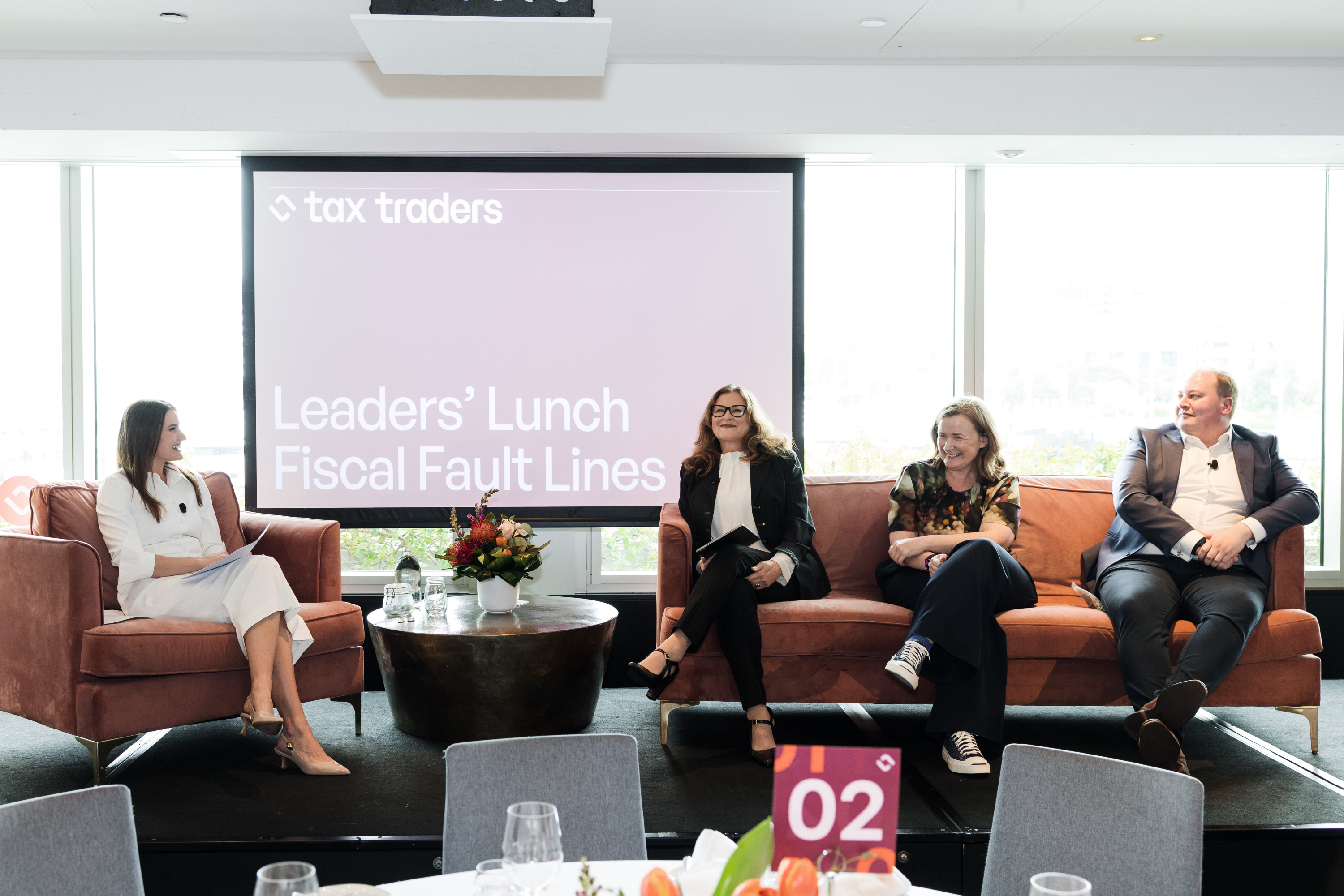
As political parties argue over capital gains taxes, wealth taxes and tax cuts in the lead-up to the election, a panel of economists, a panel of experts say New Zealand risks focusing on the symptoms rather than the underlying problem.
That was among the key takeaways from the Tax Traders’ Leaders Lunch – Fiscal Fault Lines: Who Pays for the Future We've Promised Ourselves? – held in Auckland last week, where panellists argued the nation’s biggest challenge is a growing mismatch between what New Zealand expects from Government and how it intends to pay for it.
The discussion, moderated by Madison Malone, featured Brad Olsen, Principal Economist at Infometrics, Robyn Walker, Tax Partner at Deloitte New Zealand, and Josie Pagani, political commentator, columnist and Chief Executive of ChildFund NZ.
Attendees included business leaders, CFOs, tax managers and professional advisers from across New Zealand.
Opening the event, Tax Traders Co-Founder Nicola Taylor said the discussion was deliberately focused on the issues sitting beneath the election campaign.
“We believe business can be a force for good, and part of that is convening difficult conversations, uncomfortable conversations, and answering hard questions.
“One of the hard questions that we keep hearing, buried in all the tax policy and all the political rhetoric, is this: how are we going to pay for this future that we've promised ourselves?”
A structural problem, not just a tax problem
“At the moment core Crown revenue ... is about 31 percent of GDP, and spending is 33 percent of GDP.”
Olsen said that gap is expected to equate to roughly $15 billion next year.
He compared the situation to using Afterpay to pay for groceries, arguing that New Zealand had become increasingly reliant on borrowing to fund day-to-day costs.
“About 80 percent of the additional borrowing by Government in the last 12 months was for operating spending.”
Asked whether politicians were confronting the country's long-term fiscal challenges or merely delaying difficult decisions, his response was direct.
“More the latter.”
The panel broadly agreed that population ageing, healthcare funding, productivity and superannuation sustainability are receiving less attention than they deserve during the election campaign.
The election campaign under scrutiny
The panel also questioned whether the election campaign was doing enough to engage with the underlying issues facing New Zealand.
Pagani describes the contest as “the checkout election”.
“It really is fifty shades of beige.”
While she welcomed the willingness of smaller parties to put bigger ideas on the table, she suggested many of those proposals lacked the practical grounding needed to gain broader support.
“The smaller parties come in a little bit like punk rock in the ‘70s, just throwing the door open, going land tax, wealth tax...”
Ultimately, Pagani argued that neither caution nor radicalism alone would solve the country's long-term challenges.
“The radical people need to be more sensible and the sensible people need to be more radical.”
Certainty matters too
Walker argued that public debate often focuses on tax rates while overlooking the importance of certainty, simplicity and practical implementation.
“There's nothing worse than flip-flopping. If people don't have certainty that the rule is going to exist, then the policy, which is actually really good, doesn't have any effect, because people can't factor it in.”
She said frequent changes to tax settings can undermine otherwise worthwhile policies and create unnecessary costs for businesses trying to plan and invest.
“Complexity becomes a real dead-weight cost on everybody.”
The future we've promised ourselves
Pagani argued that New Zealand's expectations and tax settings are increasingly at odds.
“What we want is Scandinavian-level services with an Anglo-Saxon tax system, and that's a problem.”
She suggested that public frustration was driven less by taxation itself and more by what people are receiving in return.
“I think most New Zealanders are actually criticising the service they're getting, whether it's health or education, for the tax spend. That's the problem. The trust has gone.”
Olsen pointed to one statistic he believes deserves greater scrutiny.
“We still spend more on [New Zealand] Super every single year than the entire education system budget. Follow the numbers.”
Beyond the tax debate
While the discussion covered competing election tax proposals, the panel repeatedly returned to productivity and economic growth as the missing conversation.
“Tax isn't going to grow the economy," said Pagani.
She argued New Zealand needed a stronger focus on productivity, competition and long-term economic growth rather than relying solely on changes to tax settings.
The panellists also differed on aspects of tax policy.
Walker argued that good tax design should focus on raising revenue efficiently while minimising avoidance opportunities and complexity.
“The more you tax something, the less you'll get of it. That's why GST is such a good tax, because there isn't any avoiding it.”
Speaking in a personal capacity, Walker argued that if the objective was simply to raise more revenue, a higher GST rate combined with compensation for lower-income households would be a more effective solution than a capital gains tax.
A 1% increase in GST would raise roughly $3 billion, she noted.
"We are a small country and we need to raise revenue efficiently. If you want an efficient tax system that raises as much money as possible for the least cost, then a capital gains tax raises next to no money.
"The best reason to introduce a capital gains tax is so that we can stop talking about it. It's so tedious."
Olsen agreed that GST was the most efficient revenue-raising tool, but cautioned that tax policy also needed to consider broader questions of fairness and behaviour.
“That's why, for a decade or so, I've been a proponent of a capital gains tax. Not because I like it as a tax idea, but because I'm worried that during Covid my wage was worth less than what a house would make, and it's made out of weatherboard when I'm made of skin and bone. That didn't feel right.”
Tough choices ahead
Despite differing views on the best policy responses, the panellists agreed that New Zealand could no longer avoid difficult conversations about the country's long-term fiscal future.
Closing the event, Tax Traders Co-Founder Josh Taylor urged New Zealanders to engage more directly with the choices facing New Zealand.
“The hard questions do need to be asked.
“The sooner we can collectively have the courage to lean into those and face those hard decisions, the better the possibilities of great outcomes for our country.”
Editor's note: Since the discussion took place, Treasury's Pre-election Economic and Fiscal Update (PREFU), released on 29 September, has pointed to an improved near-term fiscal outlook, including lower forecast deficits and a reduced borrowing programme. However, it also reinforces many of the longer-term themes discussed at Fiscal Fault Lines, including fiscal sustainability, economic growth and the pressures associated with an ageing population.